Shooting old technology to the moon


Researcher partnering with an engineering and product team
MY ROLE
methods
Literature review, phone interviews, surveys, mobile video study, field interviews
Launched a business
impact
Role Context
I worked on this project within a division of the larger organization, and this team operated as an incubator. Ideas were generated and vetted rapidly to assess their potential for becoming viable independent businesses, with the unique requirement that they were "moonshots." The mantra that drove this classification is that innovations cannot just be 10% better than what existed before, they should aim to be 10X better and have global impact 10-20 years down the line.
The team doing the quick vetting had a skill mixture that was heavy on engineering, meaning that projects were often focused on evaluating the technical feasibility of the idea. This was a slow process, taking upwards of 6 months to reach a go/no-go decision, which boiled down to:
"Do we have reason to believe this COULD become a viable business and have the impact we want to have, enough to invest more money into research and development?"
I was one of the first few researchers partnering with this team for the vetting process, essentially an "experiment" to see if adding research could provide value to the decisions being made.
My job: For each project, identify the core questions that need to be answered and assumptions that need to be tested to make a confident go/no-go decision. Then, answer them so that the eventual decision is more well-informed, and hopefully faster than it could have been done before.
My job in simpler terms: Either kill the idea or help launch a business, but do it quick!
I'll break down the idea into 3 components:
The global problem: Climate change. Luckily, this was not the team's first or only exploration into the problem space, so there wasn't an overly-optimistic assumption that we would be developing a silver bullet to solve everything. This idea was targeted at one of the largest sources of greenhouse gas emissions: buildings. Typical heating and cooling technology uses some combination of electricity and burning some type of fuel (sometimes to generate electricity). If all buildings transitioned to an HVAC solution that produces little to no greenhouse gases, that's a big dent in overall emissions.
The moonshot idea to tackle the problem: "Green" heating and cooling exists, but it's not very popular. According to physicists, the most energy-efficient way to heat and cool a space is a heat pump. Specifically, a geothermal heat pump. This technology is decades old, really expensive to install, and not very popular despite only using a tiny bit of electricity and requiring no fuels. The "moonshot" was a technical innovation that drastically reduced the cost and time needed for installing a geothermal HVAC system.
The human element: Homeowners love spending less on utilities. The core assumption that needed to be true was that a reduction in cost would drive adoption of geothermal HVAC. The sub-assumption that needed to be explored was that geothermal was comparable or better than its competitors on all of the other decision factors, including ones the team may not have considered, enough for a reduced price to tip the decision scale.
The idea to vet
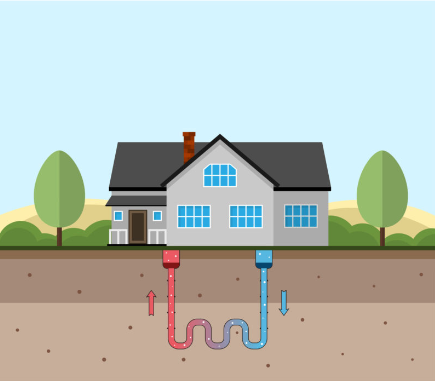
A heat pump exchanges heat between the house and coils installed underground. It is naturally cooler underground in the summer and warmer in the winter, so pumping heat this way is really efficient.
Research approach: answering the key questions
I try to break down every project into the key questions that need to be answered. Then, I go about answering them in an order based on what I need to know to proceed, how critical the information is, and how easy it is to answer.
The difference between this project and most of my other work was that there were unique milestones; early-stage ideas need to be quickly vetted with relatively limited resources, culminating in a presentation to present the case that this idea is a potential winner: global impact, technical feasibility, business viability.
Only if the idea passed the initial evaluation would there be additional resources and the go-ahead to continue pursuing the idea.
Spoiler alert, this project was one of the rare instances where an idea passed the first hurdle.
For the sake of outlining the whole process, I will describe all the steps here but they will be organized in two phases, illustrating the activities before and after the major milestone.
Research Phase 1
What are the solved and unsolved problems in heating and cooling, especially with geothermal?
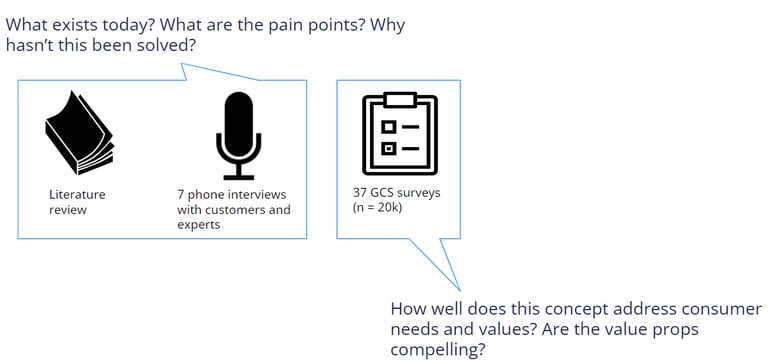
I needed to get up to speed on this problem space: to understand the world of building heating and cooling, what solutions exist and how they compare and compete, what the tradeoffs are that people care about, and what problems haven't been solved to customers' satisfaction yet, with a keen focus on geothermal solutions. To answer all of these broad questions, I did two things: a quick literature review (less than 1 week), and phone interviews with industry subject matter experts and existing geothermal customers.Are the value propositions of the team's solution aligned with customer needs and values?
Basically, does the team have reason to believe that the proposed benefits and value are compelling to the target audience? To answer this, I conducted an exhaustive series of surveys with a total sample size of about 20,000 people.
Research Phase 2
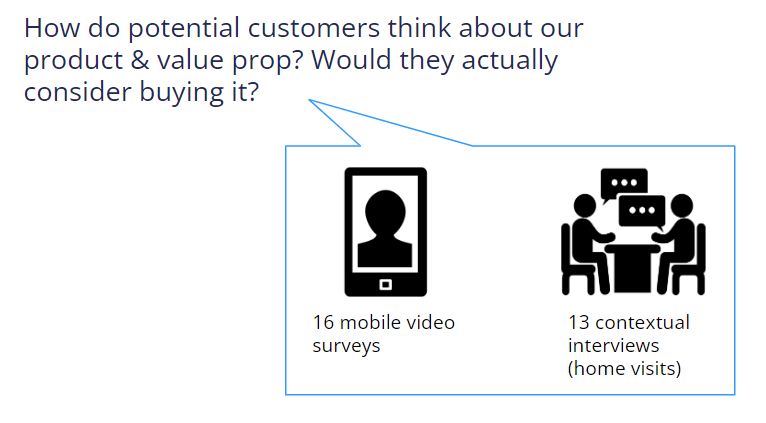
How do potential customers actually think about the product? What does their decision making process look like?
The previous research efforts were all about hypotheticals. To really de-risk the project, there was a huge need to watch actual members of the target audience react to the product and understand how they considered making a purchase decision. To answer this question, I ran a mobile video survey as a precursor to inform a field study involving contextual interviews done within people's homes.
Not the most efficient approach
For the more market research-savvy readers out there, you might have noticed that this is an odd way to test value propositions, and it is. I eventually got findings clear enough to inform the narrative, but if I was doing the same project today I would probably go with a conjoint or maxdiff analysis.
Every vetting project required a lot of rapid learning. Since I had no background in heating and cooling and was not a homeowner, this was the first time I encountered the term "geothermal hvac."
Most people on the project team were a bit ahead of me, having put together the initial case. This meant that my initial discovery activities were a balance between open exploration and targeted fact-checking.
I won't bore you with the details of the firehose of information, suffice it to say there were some things that were fascinating to me personally, but that I ultimately deemed "irrelevant for now." The only way I was able to filter information this way was by finding the right framework to think about the most important questions.
What was the biggest assumption the team was making which, if false, would kill the whole idea?
Remember, the proposal was "If we can cut installation costs to make geothermal comparable to its competitors, people will buy it because it lowers monthly utility bills and it is better for the environment."
Which meant that the core assumption was NOT about problem-solution fit, experience quality, or even product functionality. It was about the importance of price and some presumably secondary factors in customers' decision when purchasing a new hvac system for their home.
With this understanding, it was a relatively straightforward matter to both:
Filter out "extraneous" information for later reference
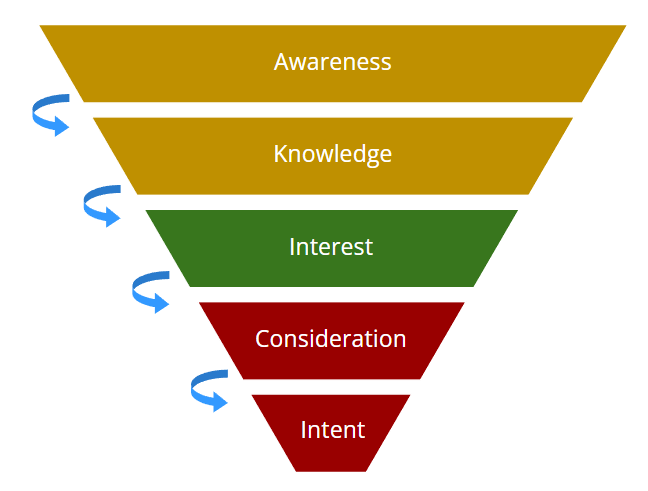
Organize critical information into a single framework: The customer adoption funnel
Question #1: What in the world is geothermal HVAC?
Question #2: Who cares?
Irrelevant now (important later)
(From a customer): Geothermal HVAC systems are totally different from forced air. The speed of temperature change is different, the noise is different, and even the feeling is not the same.
(From a geothermal SME): Geothermal customers face a particular pain point around support: It's hard to know who is a trustworthy vendor for such a niche product, and there are some scammers out there who will install a system and cut corners to save money, which might result in damage to the system and the home.
The findings, in a nutshell
The (rather un-exciting) end to this saga was that the early-stage research validated the core assumptions:
It's hard to sell a geothermal HVAC system when the (way more popular) furnace and boiler systems are significantly cheaper
The cost, time, and effort it normally takes to install one of these systems is usually a dealbreaker if customers get past the sticker price
Without considering price or details of the system, people love the idea of having near-zero monthly utility costs and an environmentally-friendly HVAC system
A nifty way to visualize all the information
I mentioned before that the customer adoption funnel was the guiding framework for this information. With all the details laid out, the addition of a basic visual showed our findings at a glance:
Homeowners generally have at least heard of geothermal HVAC
People's knowledge about geothermal is usually surface-level
People are very interested in an environmentally friendly heating and cooling system that has almost no monthly utility costs
Any initial interest tends to die when homeowners see the actual cost of the system and installation
Most people simply won't buy a geothermal system in favor of a "normal" cheaper heating and cooling system
The final message
I don't remember saying these exact words to the product team, but if I could go back and sum up the initial phase of research into a concise takeaway, it would be this:
"If you can actually make this product competitive on price and installation difficulty, you have a business."
Milestone
Getting past the first phase was relatively uneventful, other than the project accelerating in pace and fervor.
Now that the core assumptions were more or less "validated," it was time to move onto the nuanced questions and assumptions.
If you recall, there were secondary details built into the core assumption: that geothermal was comparable or better than its competitors on all of the other decision factors.
It was time to put those to the test, in a more realistic setting.
This is the question all researchers dread getting from partners: "Will people buy X"
It's also THE question that underlies essentially all the other business questions that researchers tackle.
Consideration: Goals of the research
Given that what the team needed was a reality check on whether customers would actually be interested in what they were offering, I felt the best way was to put the idea in front of customers in the most relevant context possible: as a sales pitch.
There were a lot of secondary questions as well involving customers' homes and their current heating and cooling situation, including any pain points they might be having and their values when it came to finding a better solution.
Finalizing the method
In order to build deep understanding of customers' homes and their current HVAC situation, and at the same time put them in the context of deciding on a potential product, the final plan that the team got on board with was an ethnographic-style field study involving 2-hour interviews with homeowners in their actual homes.
This became one of the biggest research efforts I've ever been involved in my whole career:
The home visits were done out-of-state (targeting a geographical demographic that would benefit the most from the technology), meaning cross-country travel
The core team included myself, the product and engineering team, as well as a collaborating researcher based in the state we were visiting (who happened to be an ethnographic researcher)
Full disclosure; ethnography is not my specialty, so while this was technically "my" project, I was happy to let my collaborator take the lead in terms of guiding the methodology, though we split the workload otherwise. It's always a treat to work with subject matter experts and learn through osmosis!
In preparation for this trip, I worked closely with my design partners to prepare the "sales pitch that we would be putting in front of participants. Using what we learned from phase 1 of research around homeowners' pain points with existing products and insights about what they valued, we developed:
A storyboard of the ideal end-to-end user interaction with the product
Industrial design concepts of the geothermal system
A marketing brochure incorporating #1 and #2
Question #3: Will people actually want this?
General study structure
These interviews were semi-structured: we would touch on a few core topics, but the conversations would otherwise be free-roaming depending on each participant
Introductions and icebreakers
Tour of participants' homes and heating/cooling system
Past and current experiences with HVAC systems
Consideration factors for replacing their HVAC system
Concept test: reactions to sales pitch for the new geothermal system
Outcome: a sobering reality check
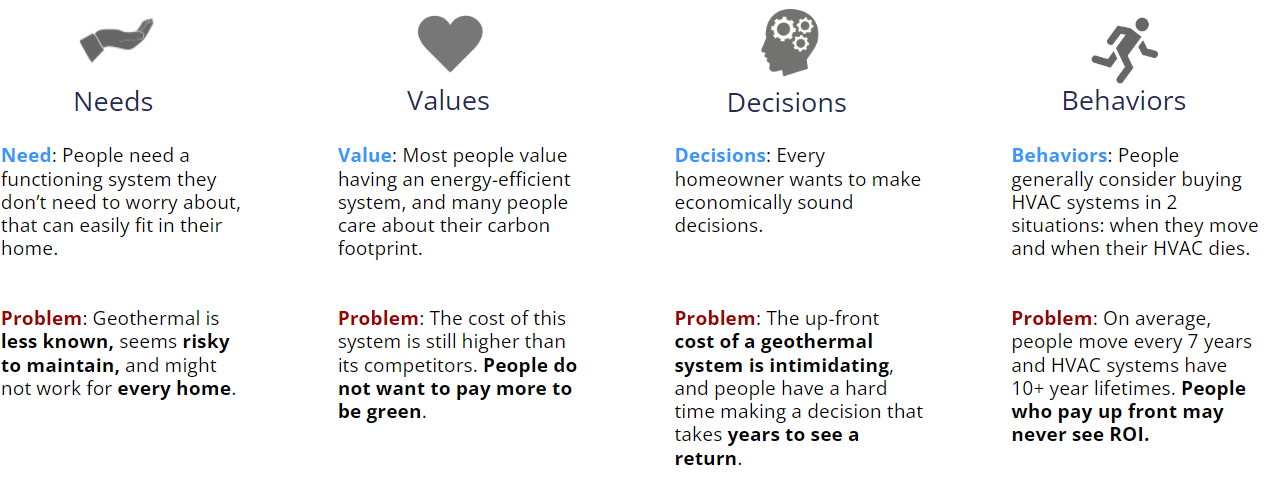
Here is what we learned about people's needs, their values, their decisions, and their behaviors.
A few more nuggets hidden among the findings:
A technical oversight: Every single home we visited had a unique setup with heating and cooling; many of them were modified by the homeowner, and several of them had our engineers shaking their heads going "this would never work with our system"
Takeaway: Applying our product to every home is not realistic due to unique differences in layout
The risks of being an early adopter: When a commoditized product like a furnace or a boiler breaks down, even if the manufacturer is not willing to fix it, finding someone else is easy. With an uncommon system, homeowners worry they won't be able to find someone with the expertise.
Takeaway: The product is more than just hardware, it's service
The price of environmentalism: I met a woman who would unplug every appliance before bed each night to avoid wasting electricity for environmental reasons. She was a no-go for the super-green geothermal system because of the comparably higher price tag compared to a gas system.
Takeaway: Expressed values don't always drive behavior
Recommendation and impact
At this point, it was time to deliver the findings to the team and disengage; the larger research + design team within the incubator-style department operated like internal consultants, and this was already one of the longest projects we had worked on together.
The final presentation included all of the findings I shared above, of course, but it also came with a takeaway that might surprise you unless you peeked at the impact description at the top of this page.
Given all of the problems and roadblocks discovered through in-depth user research, you might have expected this to be a "kill the idea before we waste more time" scenario. However, one of the benefits of working on a project with such ambitious goals is that even deep compromises leave a lot of value on the table.
The actual suggestion could be more accurately summed up as "If this is going to work, you need to reduce the scope of your moonshot goals and adjust your strategy."
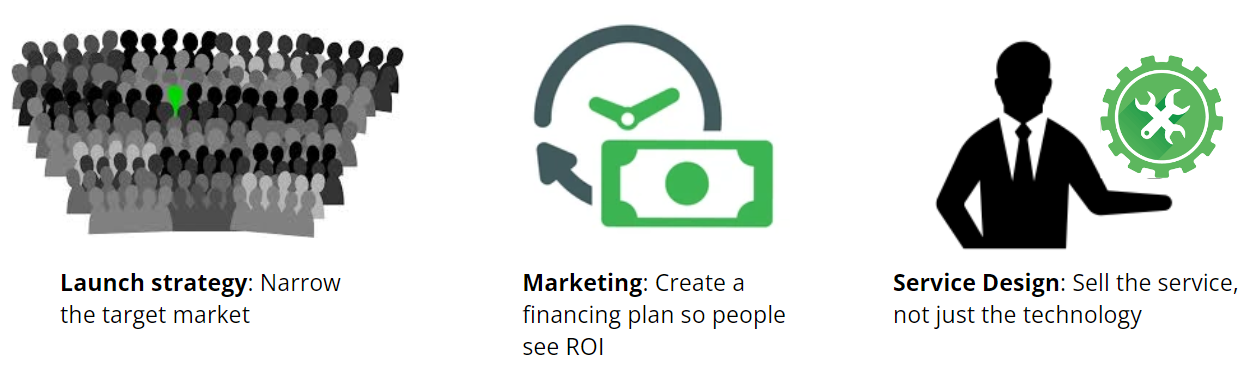
Launch strategy: The initial aspiration of "Get every building on geothermal!" was too ambitious, and a non-starter for some homes given the current technology. The suggestion here was to find the specific segment (geography, building type, etc.) that maximizes owner value, and pursue that segment to enter the market.
Marketing: The math behind the return on interest is fine, but it's missing the human need to see the benefits on a much shorter timescale. If there is a way to finance the product in a way that people see the cost comparison as a no-brainer, it could smooth over other concerns with a (currently) niche product.
Service design: Because this big-ticket product is so different and relatively unknown, people need to be able to trust that they will be taken care of if something goes wrong. You are not just selling a product, it's also a service.
After delivering this finding, I had zero interactions with this project as I moved onto other work. It wasn't until after I left the company that I discovered the impact of the work...
The business that sprang out of the ground
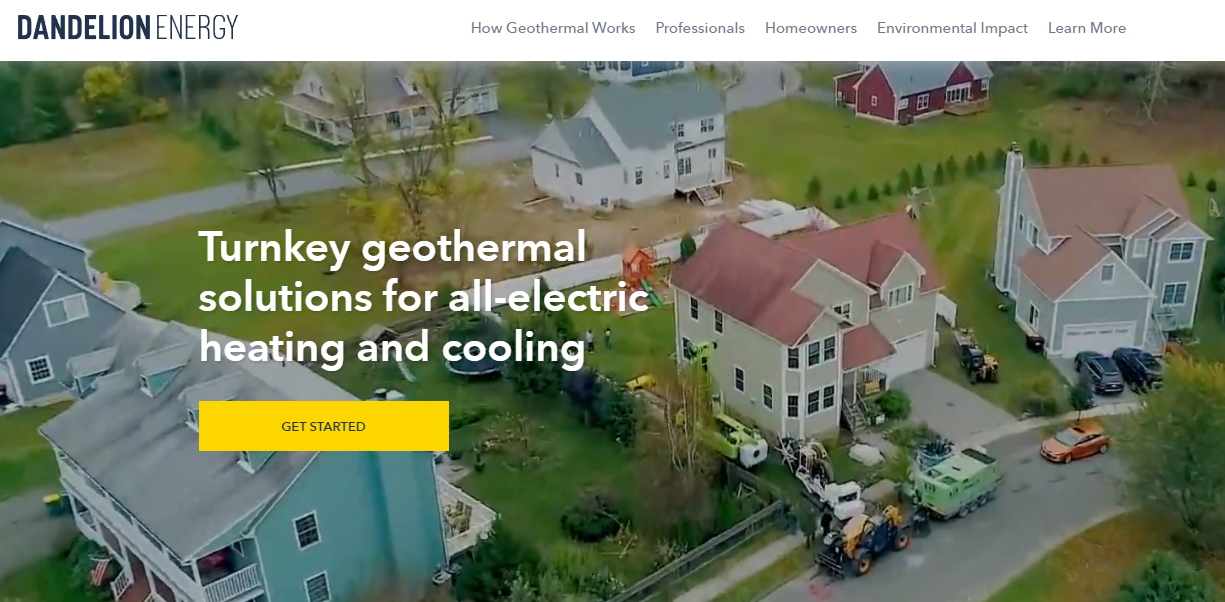
2 years after the project ended, Dandelion Energy was born as an independent business in New York.
As I suggested,
They picked a smaller geography where geothermal was likely to be especially effective to break into the market.
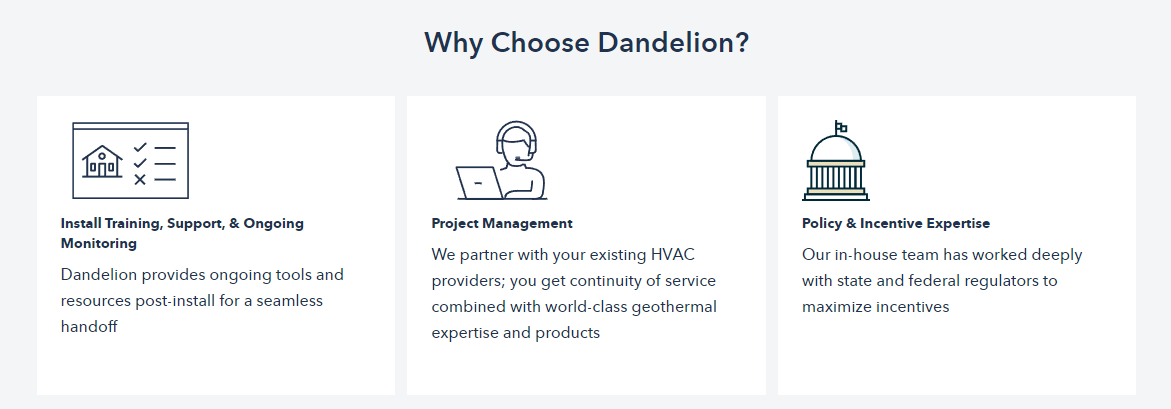
They created a financial package so that customers paid nothing up-front and got cost savings immediately. Later, they included services that helped homeowners maximize their federal and state incentives.
They leaned into customer service, initially adding live chat support to the site, and later offering partnerships with existing HVAC providers for continuity.
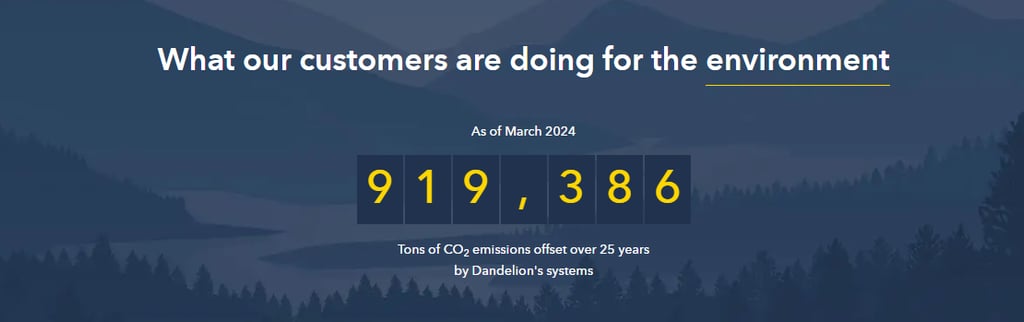
Lastly, and this is more of a data point that I'm gratified to be tangentially associated with, they also shared their contribution to the original mission of doing their part to tackle climate change: